

|
Official Medevac Helicopter Partner · Acropolis Rally Greece When the world's toughest gravel rally takes to the mountains of Greece, Fly G Aviation is in the air — ready to respond within minutes. |
|
Quick Summary
|
The Acropolis Rally Greece carries a reputation earned over seven decades of competition. Known throughout motorsport as the Rally of the Gods, it routinely delivers the most demanding conditions in the FIA World Rally Championship — sharp rocks, extreme heat, choking dust, and mountain stages that can humble the best drivers and machines in the world. Against that backdrop, the safety infrastructure required to host a round of the WRC must match the event's complexity.
Fly G Aviation is proud to serve as the Official Medevac Helicopter Partner of the Acropolis Rally Greece. This partnership places one of Greece's most experienced commercial helicopter operators at the centre of the event's emergency medical response plan — a critical role that combines operational readiness, professional aviation standards, and a deep understanding of the Greek terrain.
This article explains what that role involves, why helicopter support is fundamental to modern rally safety, and how Fly G Aviation fulfils that commitment across every stage of the event.
A Rally Born From the Rock: The History of the Acropolis Rally Greece
The Acropolis Rally has been a fixture of Greek motorsport since its inaugural running in 1951, making it one of the oldest events in competitive rally history. It joined the World Rally Championship calendar in 1973 and has remained a benchmark of endurance and mechanical punishment ever since.
The event's identity is shaped by the terrain of central Greece — limestone gravel roads that fragment into fist-sized rocks, blind crests over ridge lines, and stages that wind through olive groves and highland villages at altitudes of up to 1,000 metres. Summer temperatures routinely exceed 35°C, placing extraordinary demands on both machinery and human performance.
After a period away from the WRC calendar, the Acropolis Rally returned in 2021 to widespread acclaim. Its reinstatement confirmed what drivers and engineers had always maintained: there is no substitute for the challenge of the Greek mountains. Today it stands as one of the most anticipated rounds of the season for teams, fans, and the local communities that host it.
The 2026 edition runs from 25–28 June 2026 as Round 8 of the FIA World Rally Championship, with Fly G Aviation serving as Official Medevac Helicopter Partner throughout the competitive programme.
Why Helicopter Support Is Essential at the Acropolis Rally
An international rally is not a single race on a closed circuit. It is a moving event spread across hundreds of kilometres of public roads and remote mountain tracks, operating across multiple days and dozens of individual stages. Coordinating safety across that footprint requires capabilities that ground vehicles alone cannot provide.
Helicopter operations at a WRC event serve several distinct functions:
| Core Helicopter Roles at a WRC Event | |
| Medical Evacuation Rapid transport of injured competitors or spectators to hospital when road access is impractical or too slow. |
Stage Reconnaissance Pre-event and live inspection of special stages, enabling safety delegates and course officials to assess conditions quickly. |
| FIA Officials Transport Movement of stewards, safety delegates, and technical officials between service parks, stages, and the event base. |
Operational Command Support Aerial coordination with Rally Control, providing real-time situational awareness across the entire event footprint. |
| Media Support Aerial camera platforms providing broadcast footage across stages inaccessible to ground-based production units. |
VIP & Guest Transport Movement of sponsors, partners, and invited guests between Lamia, Athens, and rally locations across the region. |
At the Acropolis Rally specifically, many special stages are set in mountainous terrain where road access can be significantly delayed depending on stage location, closures, terrain, and traffic control. A helicopter can significantly reduce response and evacuation times compared with road-only access — and in certain situations, aerial evacuation may be the only practical option.
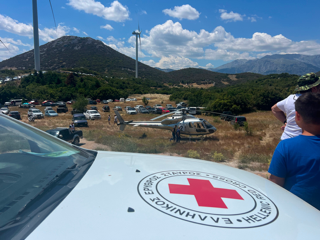
Fly G Aviation’s official medevac helicopter remains strategically positioned near Acropolis Rally stages, delivering rapid emergency medical response and advanced life support throughout the event.
Medical Safety in Modern Rallying: The FIA Framework
The FIA has invested significantly in the safety architecture surrounding world-level motorsport events. For WRC rounds, the Sporting Regulations specify clear requirements for medical provision, emergency response times, and the integration of aerial and ground resources across the event footprint.
Time-Critical Trauma Response
Trauma medicine recognises that the speed of definitive hospital care is one of the most significant factors in patient outcomes following a serious injury. This principle — that time matters enormously in trauma response — directly shapes how emergency planning is structured at international rallies, and why dedicated aerial resources are considered essential by event organisers and medical directors alike.
When a competitor's vehicle leaves the road on a remote mountain stage, ground ambulances face significant obstacles: unpaved tracks, narrow hairpin sections, and stage distances that can stretch to 30 kilometres or more. A medevac helicopter can significantly reduce overall response and evacuation times, stabilising a patient in the field and transporting them to hospital considerably faster than road-only access in many scenarios.
Coordination with Ground Emergency Services
Effective rally medical response is never a single-agency operation. The helicopter unit works in close coordination with the event's Medical Director, Rally Control, ground ambulance crews, local fire services, and the police. This integrated approach ensures that when an incident occurs, the most appropriate resource — air or ground — is activated immediately and patient handover between teams is seamless.
Fly G Aviation's Role as Official Acropolis Rally Helicopter PartnerAs the Official Medevac Helicopter Partner of the Acropolis Rally Greece, Fly G Aviation maintains a dedicated helicopter on operational standby throughout the event. That aircraft and its crew remain available for immediate deployment from the moment the first competitive section begins until the final stage is concluded each day. The operational commitment encompasses:
|
The Medevac Helicopter: Capabilities in a Rally Context
The helicopter assigned to medevac duties during a WRC event must be capable of operating in conditions that would challenge many operators. The Greek summer presents a combination of high-altitude sites, elevated ambient temperatures, and strong local winds — all of which affect helicopter performance and require careful operational planning.
Key Operational Capabilities
- Fast deployment from a pre-positioned location within the event footprint
- Ability to reach inaccessible stage locations without reliance on road infrastructure
- Temporary landing capability in restricted areas near special stages — including hillsides, meadows, and unpaved clearings
- Patient accommodation with sufficient space for a medical crew to attend to a patient in transit
- Communication systems compatible with rally command and hospital coordination networks
- Endurance sufficient to cover the operational radius of the event without interruption
Mission profiles can change rapidly during a rally stage. A helicopter crew must be prepared to transition from standby to active patient evacuation with minimal lead time, then return to readiness for any subsequent incident within the same event area.
Flying in the Rally of the Gods: Operational Challenges
The conditions that make the Acropolis Rally one of the world's most demanding driving challenges also create a demanding environment for the helicopter crews supporting it. Understanding those challenges is important context for appreciating the operational standard required of any partner assigned to this role.
|
|
||
|
|
||
|
|
Air and Ground Coordination: The Command Structure
Effective rally safety depends on seamless communication between multiple agencies operating simultaneously across a wide area. The helicopter partner is one component of a broader emergency management system that includes the following stakeholders:
| Agency / Role | Primary Responsibility |
| Rally Control | Central coordination of all incident response and communication across the event |
| Medical Director | Oversight of all medical resources, triage decisions, and hospital liaison |
| FIA Safety Delegate | Regulatory compliance, risk assessment, and liaison with stage commanders |
| Helicopter Crew (Fly G Aviation) | Aerial response, patient evacuation, and operational support throughout the event |
| Ground Ambulance Teams | Stage-side first response, patient stabilisation, and ground evacuation where appropriate |
| Greek Police (ELAS) | Public safety, road closures, crowd management, and emergency corridor maintenance |
| Fire Services | Fire suppression, vehicle extrication, and general rescue support at incident sites |
All parties operate under a unified communications protocol established before the event begins. Pre-event briefings, defined radio frequencies, and agreed procedures for different incident types ensure that when a call comes, every team knows its role.
Why Professional Helicopter Operators Matter in Motorsport
A medevac helicopter is only as effective as the operator behind it. The quality of the organisation providing the aircraft — its maintenance standards, crew training, operational procedures, and safety culture — directly determines whether that helicopter is available and capable when it is needed most.
In Greece, all commercial helicopter operators are subject to regulation by the Hellenic Civil Aviation Authority (HCAA) and must comply with European Union Aviation Safety Agency (EASA) standards. EASA regulations govern aircraft airworthiness, crew licensing, operational procedures, and maintenance programmes to the same standard applied across every EU member state.
For an event partner like Fly G Aviation, EASA compliance is not simply a regulatory requirement — it is the operational foundation that underpins every flight. Scheduled maintenance, crew qualification programmes, and documented safety management systems all contribute to an aircraft being ready and a crew being capable when the event demands it.
Experience in the local airspace also matters significantly. Crews who know the terrain, the airfield frequencies, the hospital locations, and the typical weather patterns of the Greek summer arrive at each task with contextual knowledge that cannot be improvised.
About Fly G Aviation
Fly G Aviation provides helicopter and aircraft charter services operated under EASA-compliant standards, for charter transfers, VIP transport, and aerial support services across Greece. Based in Athens, the company operates from our helipad, 15 minutes from Athens Airport, and serves destinations throughout the Greek islands and mainland.
The company's portfolio encompasses private island transfers, corporate aviation, luxury travel itineraries, and specialised aerial support assignments — including its role as Official Medevac Helicopter Partner of the Acropolis Rally Greece. Across all operations, the same principles apply: aircraft availability, crew professionalism, and a safety culture that treats every flight as a planned and managed event.
Fly G Aviation is led by Grigoris Efthimiou, founder and CEO of Fly G Aviation, with over 30 years of experience in Greek and European aviation. That experience informs how the company approaches complex operational assignments — with planning discipline, attention to regulatory compliance, and a commitment to delivering what it promises.
|
|
|
The Rally of the Gods Deserves a World-Class Safety Response
The Acropolis Rally Greece asks more of its competitors, its officials, and its safety providers than almost any other event on the WRC calendar. Its remoteness, its terrain, and its conditions create a safety environment that demands serious, experienced, and well-resourced partners at every level.
As the Official Medevac Helicopter Partner of the Acropolis Rally Greece, Fly G Aviation brings the operational capability, the EASA compliance framework, and the local knowledge to fulfil that responsibility. The role is not simply about having an Acropolis Rally helicopter available — it is about maintaining an organisation that can respond effectively, consistently, and safely across every hour of a demanding multi-day event.
The partnership reflects the broader mission of Fly G Aviation: to provide professional helicopter operations across Greece that meet the highest international standards — whether supporting a WRC round or arranging a private island transfer.
Frequently Asked Questions
What is the role of a medevac helicopter at the Acropolis Rally?
The medevac helicopter is held on operational standby throughout the event to provide rapid emergency response to any incident on or near a special stage. Its primary role is the evacuation of injured persons to appropriate medical facilities when ground evacuation would be too slow or impractical.
Why is a helicopter necessary rather than relying on ground ambulances?
Many Acropolis Rally stages are in remote mountain terrain where road access can be significantly delayed depending on stage location, closures, and terrain. A helicopter can significantly reduce overall response and evacuation times compared with road-only access — critical in serious trauma cases where faster hospital access generally improves patient outcomes.
Why does response time matter so much in rally emergency medicine?
Trauma medicine recognises that time is a critical variable in patient outcomes following serious injury. Faster access to hospital-level care generally improves the chances of survival and recovery. In rally emergency planning, this principle drives the decision to position dedicated aerial resources within the event area, where road evacuation times can be significantly extended by terrain, stage closures, and distance.
What does Fly G Aviation's role as Official Medevac Partner involve?
Fly G Aviation maintains a dedicated helicopter on standby throughout competitive stages, coordinating with the event Medical Director, Rally Control, and ground teams to respond to any incident requiring aerial support or patient evacuation.
Is Fly G Aviation regulated by EASA?
Yes. Fly G Aviation provides helicopter and aircraft charter services operated under EASA-compliant standards, and operates in compliance with European Union Aviation Safety Agency regulations and Hellenic Civil Aviation Authority requirements.
Does the helicopter fly during active stages while cars are competing?
Helicopter operations during active stages follow defined protocols agreed in advance with Rally Control, event officials, and relevant authorities to ensure the safety of both the aircraft crew and competing vehicles.
How does the helicopter land near a rally stage where there is no helipad?
Crews are trained to identify suitable landing zones in unimproved terrain. Potential landing areas near key stage sections are typically assessed during pre-event reconnaissance and incorporated into the operational plan.
What other services does Fly G Aviation provide beyond rally support?
Fly G Aviation provides helicopter and aircraft charter services across Greece, including private island transfers, corporate and VIP transport, and aerial support for events and productions. The company operates from our helipad, 15 minutes from Athens Airport.
How does Fly G Aviation manage operational readiness across a multi-day rally event?
Readiness is maintained through scheduled aircraft maintenance, crew rest management in accordance with EASA flight time limitations, and pre-event briefings covering all anticipated operational scenarios.
How can event organisers or partners contact Fly G Aviation regarding aerial support?
Event organisers, corporate partners, and institutions requiring professional helicopter support across Greece can contact Fly G Aviation directly via flyg.gr. Our team can advise on operational capabilities, availability, and requirements for specialised aviation assignments.
|
About the Author Grigoris Efthimiou — Licensed Pilot & Founder, Fly G Aviation Grigoris Efthimiou is the founder and CEO of Fly G Aviation, with over 30 years of experience in Greek and European aviation. He oversees all flight operations, safety management, and strategic partnerships — including the company's role as Official Medevac Helicopter Partner of the Acropolis Rally Greece. He writes from direct operational experience. |
|
Fly G Aviation — Greece's Professional Helicopter PROVIDER Helicopter Charters Across Greece From island transfers to corporate aviation and event support — Fly G Aviation provides helicopter and aircraft charter services operated under EASA-compliant standards. Based in Athens. Available Greece-wide. View Charter Prices Our Athens Helipad |