
|
Jump to: Direct Answer | Greek Operations | Behind Every Flight | Medevac & VIP | EASA Framework | How to Choose | Island Transfers | FAQ | Sources |
Lessons from the Official Medevac Helicopter Partner of the Acropolis Rally Greece 2026 — and why the operational standards behind complex-event aviation benefit every private charter client.Last updated: June 2026 · Written by Grigoris Efthimiou, Founder & CEO, Fly G Aviation · Reviewed by the Fly G Aviation Operations Team |
|
30+ Years Aviation Experience |
EASA Air OPS Framework | Twin-Engine Fleet |
2 Aircraft: H135 & AS355 TwinStar |
WRC Official Medevac Partner 2026 |
|
Fly G Aviation provides EASA certified helicopters and airplanes · Athens helipad, 15 minutes from Athens Airport · Twin-engine fleet · All Greek island destinations |
|
Direct Answer Safe helicopter charter operations in Greece depend on regulatory compliance under the EASA Air OPS framework, documented aircraft maintenance, trained and current flight crews, aeronautical weather assessment, weight-and-balance calculation, landing-site evaluation, fuel reserve planning, and pre-identified alternate planning. Greece adds specific operational challenges: Meltemi winds across the Aegean during summer, island terrain and density altitude in summer heat, extended overwater segments, and complex coordination with the Hellenic Civil Aviation Authority. These factors apply equally to private charter transfers and to complex event operations such as medevac support at the Acropolis Rally Greece 2026. |
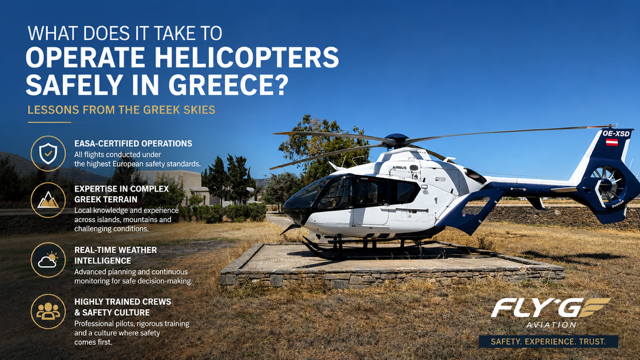
TL;DR — Quick SummaryMost private helicopter clients never see the operational work that precedes boarding. Weather briefings, crew duty calculations, weight-and-balance assessments, NOTAM checks, landing-site permissions and contingency planning all happen before a rotor turns. Fly G Aviation serves as the Official Medevac Helicopter Partner of the Acropolis Rally Greece 2026 — Round 8 of the FIA World Rally Championship, held 25–28 June. This is a strong operational trust signal and evidence of complex-event aviation capability. The same EASA Air OPS framework, maintenance standards and planning procedures applied in that role govern every commercial flight Fly G Aviation operates across the Greek islands. This article explains what responsible helicopter operations actually involve, why Greece presents particular challenges, and how operational maturity translates into more reliable private charter flights.
|
|
When most people book a private helicopter charter in Greece, three things tend to occupy their thinking: how long the flight takes, where they are going, and how comfortable the cabin will be. These are reasonable considerations — but they are almost entirely unrelated to whether a helicopter operation is genuinely well-run. Operational quality in aviation is not a product feature. It is an organisational characteristic — the result of procedural discipline, investment in maintenance, crew training, risk management systems and consistent decision-making culture. You cannot assess it from a brochure or a booking page. You can, however, look at what an operator does when the stakes are highest. The Acropolis Rally Greece is one of the most demanding events on the FIA World Rally Championship calendar. In 2026, Fly G Aviation served as the Official Medevac Helicopter Partner for the event, held across stages in mountainous terrain north of Athens from 25 to 28 June. This involved structured emergency aviation support: helicopter readiness at rally stages, coordination with rescue services and event medical teams, and the ability to respond at short notice across difficult terrain. The procedural standards required for that role share the same EASA Air OPS foundation that underpins every safe private helicopter charter. What follows is an explanation of what those standards involve, why Greek airspace and terrain demand careful management, and how they apply to every private flight across the Aegean. |
Why International Sporting Events Choose Experienced Helicopter OperatorsOrganisations staging international motorsport events do not select helicopter operators on price. Selection is based on demonstrated capability, regulatory standing, maintenance records and crew qualifications. The consequences of poor helicopter support in a medical emergency are severe enough that event organisers, insurance underwriters and national civil aviation authorities all have a direct interest in which operators are deployed. For a WRC event like the Acropolis Rally, the helicopter operator must demonstrate several things. The table below summarises the core requirements:
One aspect of rally helicopter support that is often misunderstood: readiness itself is the mission. During a rally stage, the helicopter may not transport anyone. But it must be capable of doing so safely at any moment. Sustaining that state across long operational days, in summer heat, at varying altitude, without degradation in crew performance or aircraft systems, is a more demanding discipline than flying a schedule of routine transfers. That capacity — to remain fully prepared regardless of whether a mission is activated — is a strong operational trust signal, and one that private charter clients benefit from even if they never see it. |
Operating in Greece Is More Demanding Than It Looks
Safe helicopter operations in Greece rely on rigorous flight planning, EASA-certified operational standards, experienced crews, weather assessment, and careful destination risk evaluation before every mission. Terrain and Density AltitudeThe terrain surrounding the Acropolis Rally stages north of Athens — and across much of mainland Greece — involves ridge lines, confined valleys and unprepared landing zones. Even at modest elevations, the combination of heat and altitude produces a phenomenon known as density altitude: the aircraft performs as though it occupies a higher altitude than it physically does. In summer temperatures well above 30°C, this directly affects payload, hover capability and approach performance. Island operations involve the same calculation. Landing at a private villa helipad in Santorini or Mykonos in July, in high temperatures with a full passenger complement and luggage, requires the same performance assessment that mountainous event operations demand. The Meltemi WindThe Meltemi is a dry northerly wind that typically dominates the Aegean from June through August, building during the afternoon. Wind speeds regularly reach 25–35 knots over open water and can increase sharply over island terrain, generating turbulence in the lee of ridges and unpredictable surface conditions at island helipads. Flight planning in Greece during summer is, in significant part, a wind management exercise. Departure timing, routing, altitude selection and alternate planning are all influenced by Meltemi forecasting. Temporary and Confined Landing AreasRally stage helicopter positions are often temporary, unimproved areas — cleared ground, a widened track, a field edge. The crew must assess surface conditions, identify obstacles, confirm the approach path is clear of electrical lines or other hazards, and establish a safe landing profile in a short timeframe. Private charter clients increasingly request landings at hotel helipads, private properties and remote island locations that present exactly the same assessment challenges. Experience gained in rally environments transfers directly. Coordination and CommunicationOperating within a complex event like the Acropolis Rally requires coordination with the Hellenic Civil Aviation Authority (HCAA), air traffic control, event medical teams, police aviation units and the WRC safety delegate. That multi-agency communication discipline — managing multiple contacts simultaneously while maintaining situational awareness — translates directly to smooth execution of private charter operations involving hotels, private terminals, customs officials and client ground coordinators. |
What Private Clients Never See Before a Helicopter FlightA helicopter arriving on time, in good condition, with a well-prepared crew, looks effortless. The work that precedes it is not. For any commercial flight under the EASA Air OPS framework, the operational chain begins hours before the client reaches the helipad.
None of this is visible to the client. They see a helicopter. Behind it is a documented chain that a trained operations team completed in the preceding hours. |
|
Planning a private helicopter transfer in Greece? Request a Flight Quote |
How Emergency Aviation Capability Benefits Private Charter ClientsEmergency medical aviation and private VIP charter are different missions. The equipment, cabin configuration and crew roles differ considerably. But the procedural foundation is shared — and the disciplines that make emergency aviation reliable also make commercial charter more consistently well-managed. Crew Resource ManagementCRM — the structured approach to how a flight crew communicates, shares situational awareness and manages decisions — was developed in commercial aviation after accident investigations repeatedly identified crew communication breakdowns as contributing factors. In helicopter operations, particularly in confined or complex environments, CRM is the mechanism by which a crew catches errors before they become events. Emergency standby operations reinforce CRM in ways that routine flying does not. When a crew has operated under the time pressure of a medical standby mission — where coordination timelines are compressed and consequences of poor communication are immediate — their baseline performance in routine operations reflects that experience. Maintenance StandardsAn aircraft maintained to the standard required for emergency deployment availability is, by the nature of that requirement, kept to a consistent and well-documented baseline. Unscheduled maintenance findings — the unexpected technical items that arise between scheduled checks — are identified and resolved promptly in organisations where aircraft availability is operationally essential. Operational Depth vs. Flight Hours AloneExperience under varied conditions is not the same as accumulated flight hours. An operator with extensive hours from routine island transfers and an operator with experience that also includes emergency support roles, complex event coordination and difficult-environment flying develop different organisational depth — even if the first has more total logged time. That depth is what clients benefit from in situations that fall outside the routine. |
What Private Clients Actually Benefit FromThe Acropolis Rally partnership provides evidence of complex-event aviation capability that cannot be manufactured through marketing. Being accepted as the official medevac helicopter partner for a FIA World Rally Championship event reflects a demonstrated standard — one assessed by organisations that have an operational interest in the result. For private clients, this translates into three practical areas:
This is not reassurance. It is the objective difference between an operator that has built these capabilities through genuine operational experience and one that has not. |
Understanding the EASA Air OPS FrameworkThe European Union Aviation Safety Agency governs civil aviation across 31 European states. For commercial helicopter operations, operating within the EASA Air OPS regulatory framework is the baseline legal requirement — not an optional quality designation. The governing regulation is Commission Regulation (EU) No 965/2012 and its associated amendments.
In Greece, the national competent authority responsible for issuing and overseeing Air Operator Certificates is the Hellenic Civil Aviation Authority (HCAA). HCAA conducts regulatory oversight of operators under its jurisdiction in accordance with EASA standards, which are harmonised across all EASA member states. The standards applicable in Athens are the same as those applicable in Paris, Oslo or Rome. These frameworks exist for a specific reason: aviation incidents rarely result from a single catastrophic failure. They typically accumulate through a series of smaller operational deviations, each manageable in isolation. Regulatory systems are designed to interrupt that accumulation — to create conditions where individual deviations are identified and corrected before they compound. They do not eliminate risk. They structure the means by which risk is consistently managed. |
How to Choose a Helicopter Operator in GreecePrivate helicopter charter in Greece is marketed largely on price, convenience and aircraft photographs. None of these factors reliably indicate the quality of an operator's procedures. The genuine differentiators are less visible. The following checklist covers what actually matters when evaluating any commercial helicopter operator:
Selecting on price alone means choosing without any of the information that meaningfully reflects operational quality. The Fly G Aviation pricing and destinations hub provides transparent route pricing alongside full operational details for every island route. |
How Fly G Aviation Applies These Standards to Greek Island TransfersFly G Aviation provides EASA certified helicopters and airplanes, operating from a private helipad 15 minutes from Athens Airport, serving destinations across the Cyclades and beyond. Popular routes include Athens to Mykonos, Athens to Santorini, Athens to Paros, Athens to Milos, Athens to Sifnos and Athens to Naxos. Every flight begins with the same operational process described above. See the full map of helicopter landing sites across the Cyclades for all destinations served. Weather Assessment for Aegean RoutesWeather review for an island transfer typically starts the evening before for early morning departures, and is updated close to the scheduled flight. For Aegean routes, the relevant parameters include surface wind speed and direction at both departure and destination, sea state for extended overwater segments, visibility, any convective activity over the mainland, and the Meltemi forecast for afternoon flights. A helicopter transfer from Athens to Mykonos covers approximately 150 kilometres of Aegean water. Both the en-route and destination weather must be assessed before departure. Arrival Coordination at Island DestinationsHotel helipads in destinations such as Mykonos and Santorini operate under specific permissions from the Hellenic Civil Aviation Authority. Arrival times are coordinated with the property in advance. Luggage handling — particularly for clients arriving at a private villa or transferring from a superyacht — requires advance coordination to ensure ground teams are ready and the aircraft can complete its turnaround without extended ground time in potentially high-wind conditions. Contingency PlanningIf a destination helipad becomes suddenly unavailable — a common occurrence at busy island properties during peak season — the crew needs a pre-identified alternate, not an improvised one. This planning is completed during the pre-flight phase, before the aircraft departs over open water. Aircraft OperatedFly G Aviation operates the Airbus H135 (up to 6 passengers) and the Airbus AS355 TwinStar (up to 5 passengers). Both are twin-engine aircraft providing commercial aviation services operated under an Air Operator Certificate and the EASA Air OPS regulatory framework. See the full private helicopter charter Greece guide for all routes, aircraft and pricing. Passengers receive a safety briefing before boarding, covering door operation, seatbelt use, emergency exit location, and flotation equipment where fitted. This is a genuine operational step — a passenger who understands what to do in an unexpected situation is a safer passenger. |
Why Operational Breadth MattersAviation organisations develop through experience — but only when that experience is varied. An operator whose operational history consists entirely of island transfers in good-weather peak-season conditions has a narrower knowledge base than one that has also managed emergency standby roles, complex event coordination, mainland mountain operations and time-sensitive corporate flights. The Acropolis Rally 2026 medevac role adds a specific and well-documented dimension to that experience base: sustained operations in mountainous terrain north of Athens, summer heat, temporary landing zones and multi-agency coordination — the same environment encountered across many Greek private charter scenarios. Different types of operational work build different capabilities:
Together, these threads build an organisation that has encountered a wide range of scenarios, documented what it learned, adjusted its procedures accordingly, and is better prepared for unfamiliar situations than an operator working within a narrower experience base. That is what operational breadth produces: not simply more hours, but deeper institutional knowledge. |
|
View private helicopter routes across the Greek islands Explore Routes & Prices |
Frequently Asked Questions
|
Sources & Regulatory ContextThe regulatory information in this article relates to publicly available EASA and Hellenic Civil Aviation Authority frameworks. The following sources and context apply:
|
Conclusion: Luxury Is One Part of the PictureThe experience of a private helicopter transfer — the views, the speed, the absence of queues — is genuinely exceptional. It is also the least consequential dimension of what a responsible operator provides. What matters is what happens before boarding: the weather assessment completed hours before departure, the weight-and-balance calculation that limits luggage without apology, the alternate landing site identified in case the primary is unavailable, the crew that coordinated calmly across multiple agencies at a WRC rally stage and applies that same structured approach to every island transfer. The Acropolis Rally Greece medevac partnership is a strong operational trust signal and evidence of complex-event aviation capability. It reflects the operational culture and EASA Air OPS standards that Fly G Aviation has built and maintains — standards that govern every flight the company operates, from a short transfer to Milos to a multi-stop itinerary across the Cyclades. For clients who want to understand what they are actually choosing when they book a private helicopter in Greece, that distinction is worth knowing. |
|
This article is for general information only. Final flight decisions are always made by the aircraft commander and operations team according to weather, performance, regulatory and safety requirements. Operational procedures described are illustrative of industry-standard commercial helicopter operations under the EASA Air OPS framework and should not be construed as specific commitments for any individual flight. Regulatory references are based on publicly available EASA and HCAA frameworks. |
|
Written by Grigoris Efthimiou Founder & CEO, Fly G Aviation · Licensed Pilot · 30+ Years in Greek and European Aviation Grigoris Efthimiou has founded and operated multiple aviation companies across Greece and Europe over a career spanning more than three decades. As a licensed pilot and the founder of Fly G Aviation, he oversees flight operations, regulatory compliance and safety management for the company's twin-engine fleet. Fly G Aviation provides EASA certified helicopters and airplanes, operating from a private helipad 15 minutes from Athens Airport, serving private clients, corporate travellers and yacht owners across the Greek islands. Reviewed by Fly G Aviation Operations Team · Last updated: June 2026 This article was reviewed for operational accuracy by the Fly G Aviation operations team. Regulatory references are based on the EASA Air OPS framework and publicly available aviation authority guidance. Final operational decisions remain the responsibility of the aircraft commander. Meet the Fly G Aviation team → | Fly G Aviation in the media → | Google Business Profile → | Google Reviews → |
|
Plan your private helicopter flight across Greece Fly G Aviation provides EASA certified helicopters and airplanes. Our helipad is 15 minutes from Athens Airport. Request a Charter Quote |


Copyright © 2026 All Rights Reserved